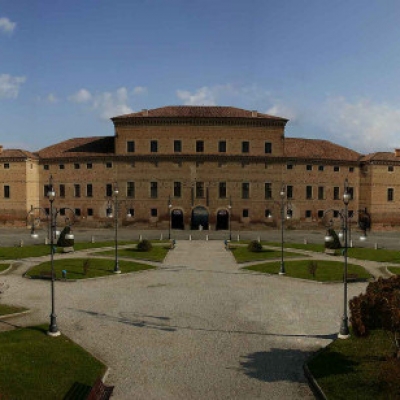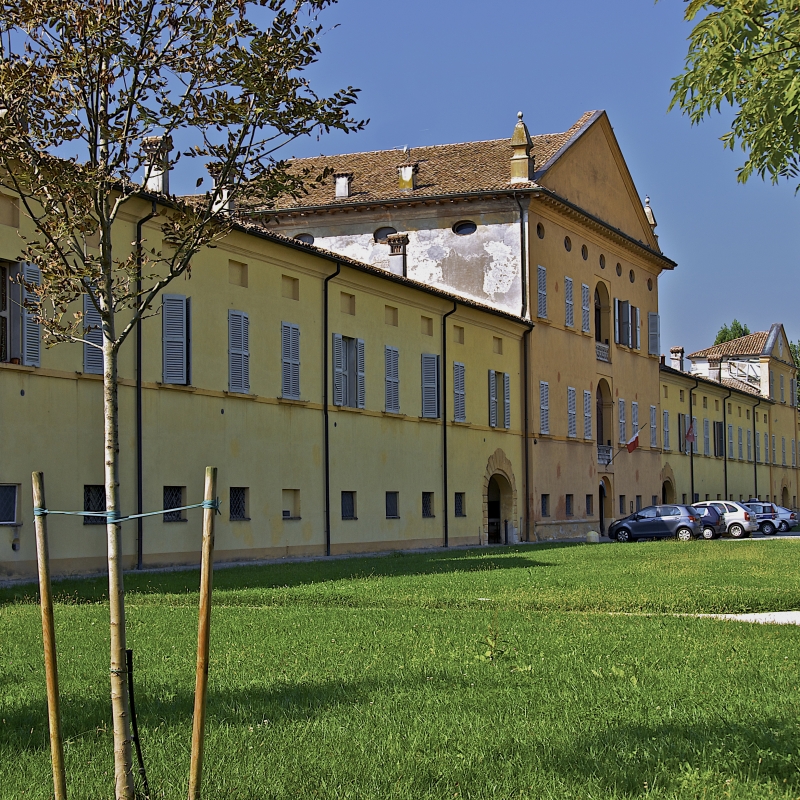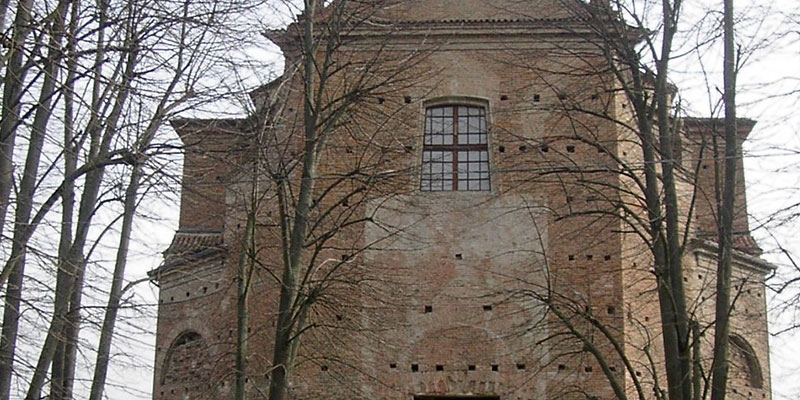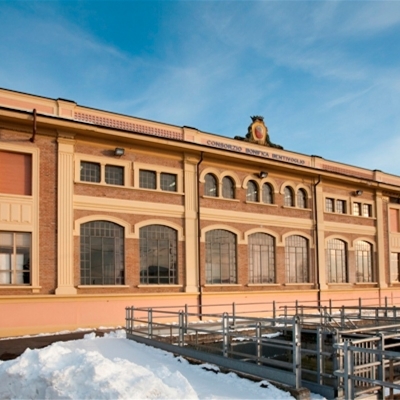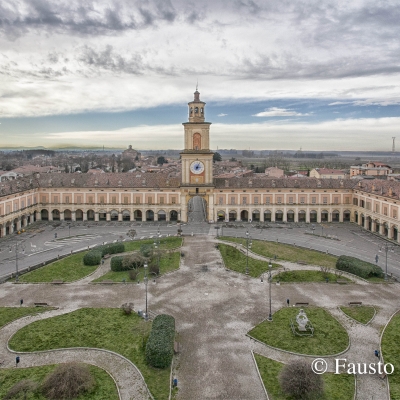
Designed by Giovan Battista Aleotti at the request of Ippolito Bentivoglio, the palace was built between 1594 and 1608, incorporating within its structure the old residence of Ippolito’s father, Cornelio.
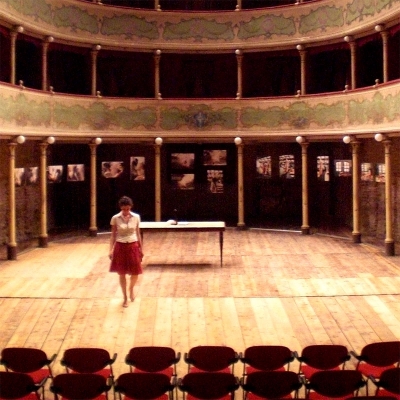
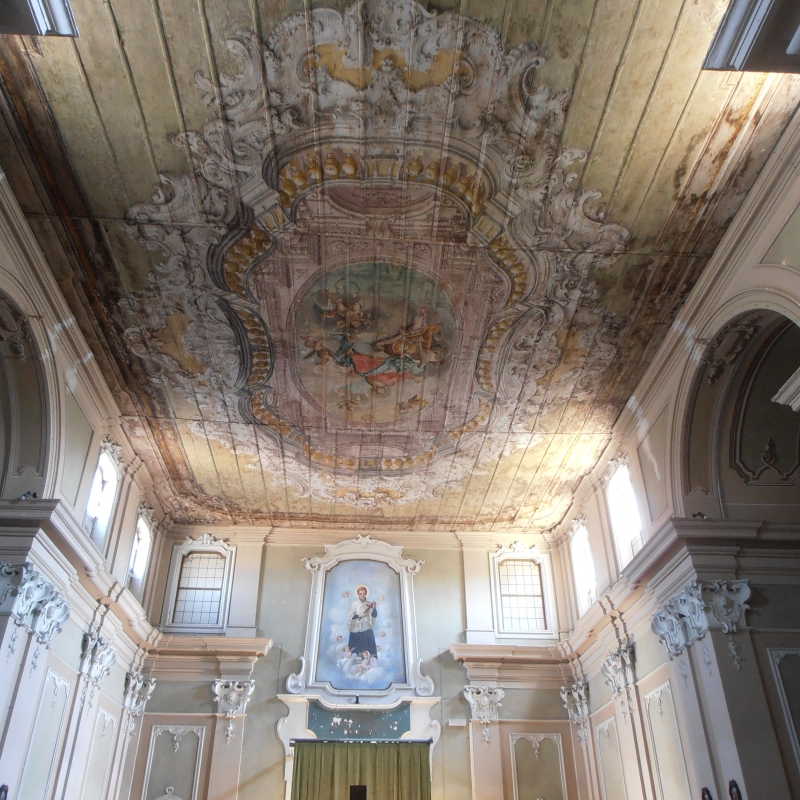
Originally, Bentivoglio Palace was conceived as a true fortress, with four façades each 90 metres long, ending in corner towers. In 1751 most of the building was demolished to provide materials for reinforcing the River Po’s embankment. The imposing main façade was spared, and at the beginning of the 20th century three archways were opened in it. Inside, the Palace once housed grand reception rooms, which today have been repurposed for museums, cultural activities, and community use. The north wing is entirely occupied by the Teatro Sociale (a theatre), while the south wing contains the Sala dei Falegnami (Eng. Carpenters’ Hall), a multifunctional environment for meetings and conferences. At the center of the upper floor, managed by the Fondazione Museo Antonio Ligabue (Antonio Ligabue Museum Foundation), is the Salone dei Giganti (Hall of the Giants): a striking 17-metre-tall hall, frescoed during the Bentivoglio family’s golden age with scenes from Gerusalemme Liberata (Eng. Jerusalem Delivered) by Torquato Tasso. Beside it are smaller rooms: the Hall of Icarus (Sala di Icaro), the Hall of Jupiter (Sala di Giove), the Hall of Aeneas (Sala di Enea) and the noble family chapel.
Audio Tour ENG : Bentivoglio Palace
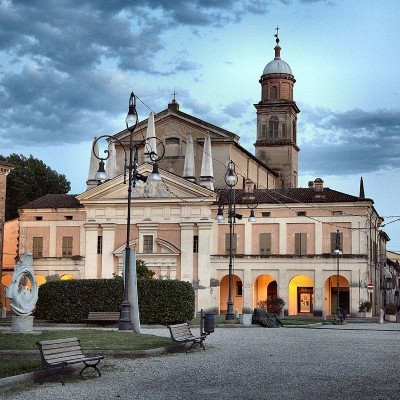
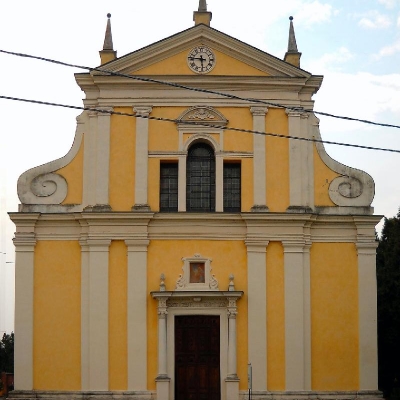
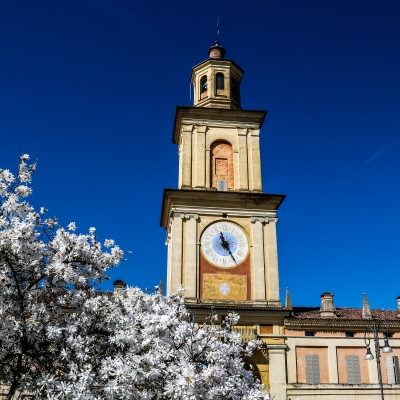
The Palace stands on Piazza Bentivoglio, one of the most beautiful small squares in Italy. Also designed by Aleotti, the square is the heart of Gualtieri and an unmissable stop on any visit to the town. It is a perfect square, 96 metres on each side, three of them lined with 69 round arches, forming wide porticoes that create evocative plays of light and shadow. The alternation of pinnacles and architectural aediculae crowns the whole, giving it a vertical rhythm. The original paving of the square, lying about 90 cm lower, is in brick laid in a herringbone pattern. On the west side rises the Torre Civica (Civic Tower); to the south stands the Church of Santa Maria della Neve; and to the east looms the majestic façade of the Marchionale Palace, to which the square serves as an honorary courtyard. Its breathtaking theatricality never fails to astonish, at any hour of the day and in any season of the year.
Audio Tour ENG : Bentivoglio Square
The Palace also houses the Museo Documentario (a documentary museum) dedicated to the painter Antonio Ligabue, as well as the Donazione Umberto Torelli (see below).
ANTONIO LIGABUE MUSEUM
The Antonio Ligabue Museum was established in 1988 by the Municipality of Gualtieri, in the Hall of Jupiter, to showcase archival documents, photographs, paintings, sculptures and films made by Raffaele Andreassi in 1960 and 1962.
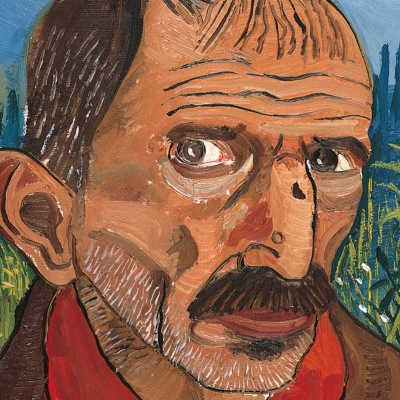
Ligabue was born in Zurich on December 18, 1899, to Elisabetta Costa and Bonfiglio Laccabue, who had emigrated from Gualtieri. In 1919, after being expelled from Switzerland, Ligabue arrived in Gualtieri, where he would spend most of his life, often mocked and misunderstood. The Municipality granted him accommodation in the Mendicomio (almshouse), but for many years he lived in the floodplain of the River Po. There, in 1929, he was discovered by the sculptor Marino Mazzacurati. Today, Ligabue is regarded as one of the greatest exponents of Expressionism. His most celebrated works include his self-portraits, depictions of both wild and domestic animals, and paintings of his Guzzi motorbikes. He was hospitalized three times in the psychiatric hospital of Reggio Emilia, and it was only in 1961, with a major exhibition in Rome, that he gained international recognition. He died in Gualtieri on May 27, 1965, following a stroke. His friend Andrea Mozzali placed a bronze death mask over his grave.
In 2014 the Antonio Ligabue Museum Foundation (Fondazione Museo Antonio Ligabue) was established to promote his artistic legacy and to make him a symbol of and encouragement to cultural and social development for the community of Gualtieri - a community that, over time, has come to recognize in Ligabue a cornerstone of its own identity and history.
Audio Tour ENG : Antonio Ligabue Museum
UMBERTO TIRELLI'S DONATION
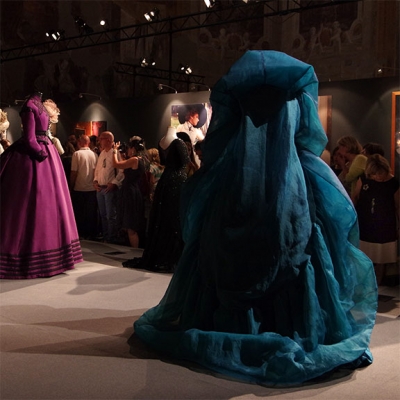
Inside the Hall of Icarus, visitors can admire the collection of paintings donated to the Municipality of Gualtieri by Umberto Tirelli (Gualtieri 1928 - Rome 1990), a celebrated theatrical tailor, and by Dino Trappetti, heir to the Tirelli tailoring house (Sartoria Tirelli). Established in 1992, the donation comprises 53 works by friends of the Tirelli family, including Balthus, Cagli, Casorati, Clerici, De Chirico, Gattuso, Maccari, and Manzù. Also in display in the same hall are two notable costumes: a stage custom designed by Pier Luigi Pizzi and worn by actor Romolo Valli in Pirandello’s Enrico IV, and a film costume worn by actress Romy Schneider Visconti’s Ludwig. In 1986, Tirelli made a major donation to the Palazzo Pitti (Pitti Palace) in Florence, which led to creation of the renowned Museo del Costume (Costume Museum). Tirelli is remembered as one of the most important costume designers in the history of theatre and cinema, contributing to the production of such iconic films as: il Gattopardo, Casanova, Amarcord, ‘900.
Audio Tour ENG : Umberto Tirelli's donation