Church of St Andrea
Already existing in the tenth century as a simple chapel, in the XII it became a parish church, serving also for the meetings of the Gualtierese community. Here, in 1547, the Confraternity of the Conception arose, almost immediately transferred to the new oratory.
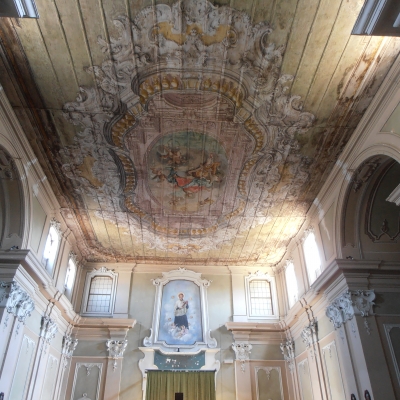
In this church, in 1566, Cornelio Bentivoglio received as a gift from the Gualtieresi their lands to reclaim them. Later in 1571 the Marquis built the bell tower and restored the complex. When Hippolytus Bentivoglio had the parish of St. Andrew transferred, he became the church of the convent. Pouring in a bad condition the Franciscan friars, with the help of the Duke Rinaldo d'Este, completely rebuilt it between 1713 and 1738, probably on the project of the ducal architect Giovan Maria Ferraroni. The new church is a refined baroque with a central plan, covered by a dome supported by Corinthian style pillars, with a large choir. In the octagonal plan, four angular chapels are inserted, highlighting an X, the shape of the cross of St. Andrew. The two choirs at the sides of the choir (located in the main chapel) are probably later. In 1765 the presbytery, the chorus, very deep, the high altar and the stucco balustrade, made by Casalgrandi plastificators, were redone. After the suppression of the convent, in 1795 it was given to civil use, and with the unity of Italy it became a municipal property.
During the First World War it was transformed into a military hospital and in 1919 it was reconsecrated and the paving was redone. The exterior has an unfinished simple façade with a mixtilinear pediment. Almost all the works kept inside date back to the 18th century, except for the statue of the Madonna of Loreto (from the 16th) and a painting by Gian Battista Bolognini depicting "San Gaetano da Tiene and S, Andrea Avellino in adoration of the Cross" (mid XVII) , from the Jesuit church of Guastalla.