Cavallotti Square

Learn

Cavallotti Square

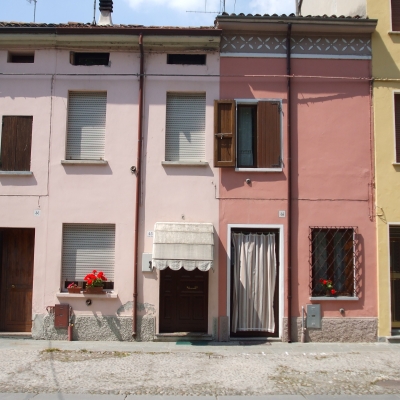
Felice Cavallotti Square was the original inhabited nucleus of Gualtieri, where a cluster of small aligned houses once surrounded a Gothic church, later replaced by the present Church of Saint Andrew in 1713. The façades of these dwellings are arranged into narrow semi-detached houses, preserving their medieval to 15th-century structure, embedded in the long, slender Gothic plot, with interaxes ranging from 2.6 to 3.5 metres. They were once inhabited by artisans, farmers and free citizens.

In this square stands the Pozzo Civico, a civic well built in 1765, when the Duke of Modena ordered the closure of the wells in the new square to prevent the rising of Po water springs, and for hygienic reasons. A single well for the entire community was therefore commissioned, and architect Giovan Battista Fattori was entrusted with its design. Fattori conceived it in the form of a small temple, placing it at the centre of the square and aligning it with the façade of the Church of Saint AndrewHis aim was to emphasize the visual perspective linking the two buildings and to enhance the perception of the square as a unified urban space. The well consists of an octagonal central body surrounded by a colonnade with Doric-Tuscan pillars, beneath which are the openings used to draw water. In 1984, the Festa del Pozzo (Eng. the Well Festival) was celebrated here, reviving the old custom dedicated to the “Rugiada di San Giovanni” (Eng. Saint John’s dew; on the night of June 23, the feast day of Saint John, according to folk tradition, people would prepare the ritual “Acqua di San Giovanni”, Saint John’s water, would be prepared - an infusion of herbs and flowers, believed to be made magical by the dew of that special night). 

The Well is also mentioned in the two following audio tours.


> Audio Tour ENG Pozzo Civico

> Audio Tour ENG Piazza Felice Cavallotti - Cavallotti Square 

Nearby